
Gift Vouchers for Your Business
Sell gift vouchers online in 1 day. No setup fees, no monthly costs – just 5% commission when you make sales.
Try KORTA!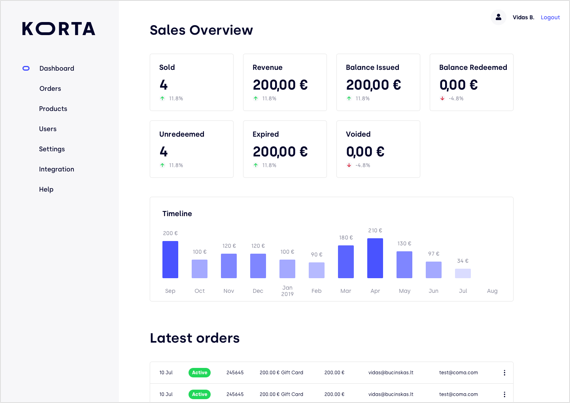
Why gift vouchers work perfectly for businesses?
Of every product a service business can add to its offer, gift vouchers are among the highest-margin. There's no inventory to buy, no warehouse to fill and no shipping to arrange. Someone pays today for a service you'll deliver months from now – and in many cases the voucher is never fully redeemed, which means real cash stays on your books. For most businesses we work with, vouchers turn into a second revenue line that grows every year without any additional staff cost.
- Perfect for any service-based business
- Attract new customers through gift vouchers
- Automatic voucher generation and management
- Increase revenue during peak seasons
Perfect solution for businesses
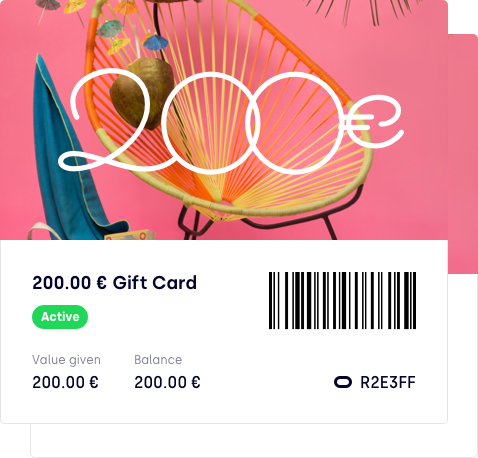
KORTA isn't tied to one industry – the same system sells yoga class packs, private chef experiences, driving-school courses, photography sessions and consulting hours. You decide whether a voucher represents a fixed amount the recipient can spend freely, a specific named service or a multi-item package; KORTA handles the checkout, the branded PDF delivery, the redemption tracking and the partial-use math. If you can describe the experience in one sentence, you can sell it as a voucher within the hour.
How to sell gift vouchers online: a practical playbook for any business
Most service businesses leave serious money on the table because they treat gift vouchers as an afterthought. The same businesses will happily invest in paid ads that convert at 2 % – and ignore a channel where a single corporate buyer can cover a week of operating costs. If you're starting from scratch, here's the short version of what actually works.
1. Build three voucher types, not fifteen. The biggest mistake is trying to mirror your entire service menu. Start with a flexible monetary voucher (three denominations: one that fits a birthday, one that fits a couple, one that fits a corporate buyer), one signature experience voucher that represents your business at its best and one premium "wow" package for when someone wants to make an impression. These three cover 90 % of real buyers without paralyzing them at checkout.
2. Treat the four gift peaks as a year-long plan. Valentine's Day, Mother's Day, the November–December corporate gifting season and the week around Christmas generate roughly 60 % of annual voucher sales for most of our clients. That's not a coincidence – it's a pattern you can exploit. Six weeks before each peak, build a seasonal landing page, take a proper photo of your signature package and email it to everyone who bought a voucher last year. No clever marketing needed – just showing up at the right time.
3. Open a corporate channel deliberately. Every town has HR managers looking right now for where to send year-end employee gifts. If your voucher page doesn't mention bulk orders, they'll skip you. Add a single line ("Buying 10 or more for your team? Send us one order and we'll deliver them all at once.") and in November, write a short email to five or ten local HR contacts. One bulk order can outearn a month of individual sales.
4. Measure redemption, not just sales. Selling a voucher is half the win – the other half is what happens when it's redeemed. A recipient walking in for the first time is the best new-customer acquisition channel you have, because the cost is already paid and they arrive ready to spend. Track how many of those recipients come back a second time within six months. That number tells you more about your business than any marketing metric.
5. Think about breakage as a feature, not a flaw. Across our customer base, roughly 10–15 % of voucher value is never redeemed – people forget, move away, lose the PDF. That revenue sits on your books as pure profit. It's not something to engineer for, but it does mean that even a modestly successful voucher program contributes more to the bottom line than most owners expect.
Marketplace or your own site: the decision that shapes the next five years
Before 2015, independent service businesses that wanted to sell gift vouchers online had basically two options: build a custom payment flow (expensive, slow) or list on a marketplace (simple, but costly in every other way). Today the second path has become the default – platforms like Treatwell in Europe, Groupon in North America and a dozen local equivalents have made it easy to start. And that's exactly where most businesses get stuck.
Marketplaces solve the technical problem at a real strategic cost. Commissions typically land between 15 % and 30 % of every sale. The customer who buys through the platform belongs to the platform – you see a masked email, not a relationship. When that customer wants to book again, the marketplace can just as easily send them to your competitor three streets away. And your brand, the thing you spent years building, shows up as a small logo inside someone else's interface.
The other path is selling gift vouchers directly from your own website. Until recently that required either custom development or a cobbled-together mix of plugins, neither of which scaled well. KORTA was built to make the direct path as easy as the marketplace path: it's a no-code plugin that drops into your existing website – you can install it yourself in a single sitting, or ask our team for free setup help – and takes 5 % only from online sales, with nothing charged for vouchers you create manually at the front desk. You keep your customer list, your brand, your pricing and your margin.
This isn't a marketplace-versus-KORTA argument – plenty of our customers use both. A marketplace listing is useful for discovery; your own voucher shop is where the real economics happen. The question is which one owns the customer relationship long term, and our answer is simple: it should be you.
Simple as 1-2-3

1. You're growing your business
You're successfully running a business and want to offer customers the option to purchase gift vouchers.
2. You reach out to KORTA
Contact us, and we'll quickly install the KORTA system tailored to your business.

3. You sell products and services
Customers purchase gift vouchers online while you track sales and enjoy additional revenue.
Simple, Risk-Free Pricing
- ✓No monthly fees
- ✓No setup costs
- ✓Only pay when you earn
- ✓Free installation in 1 day
Example: €1,000 in voucher sales = €50 commission
Frequently Asked Questions
Start selling gift vouchers today
Increase sales and attract new customers with convenient gift vouchers.
Try KORTA!